A WiFi Eyepiece for the Telescope You Already Own
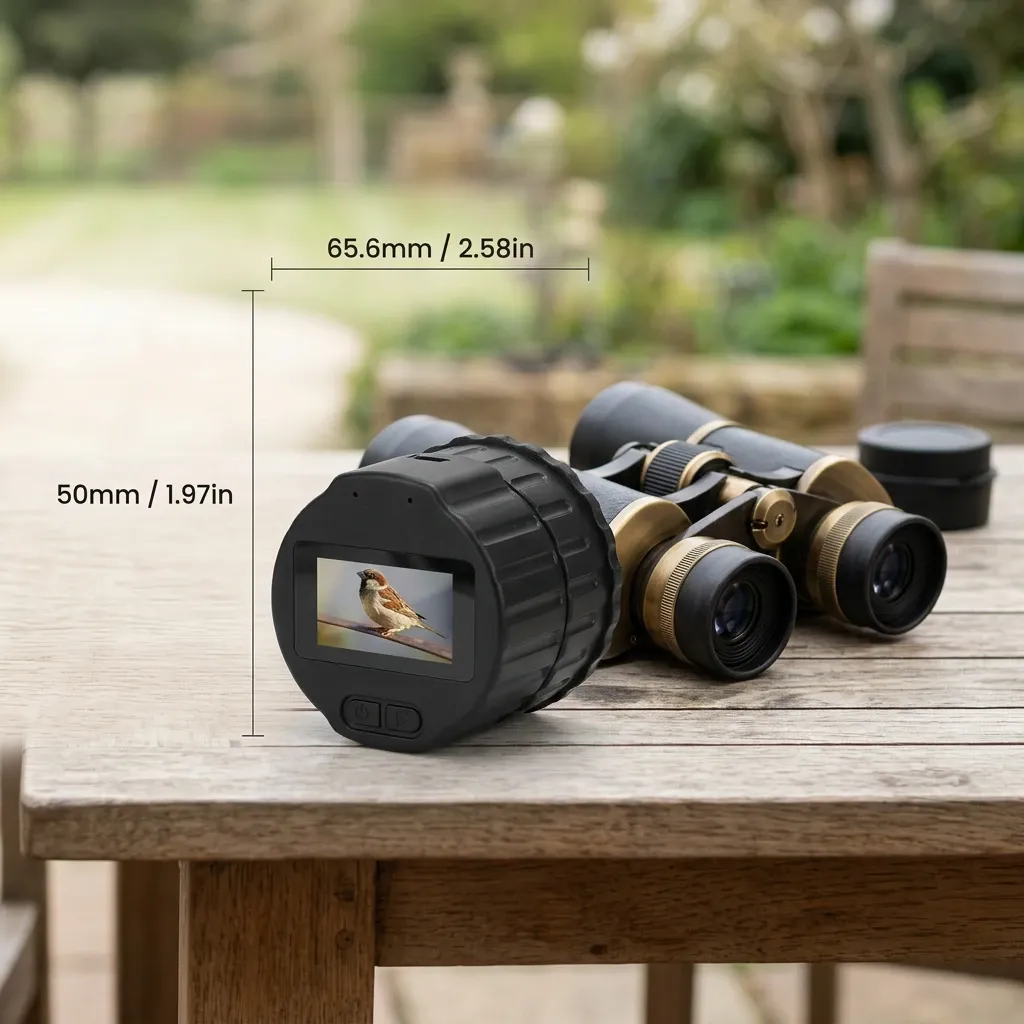
Most people who look at the V13 already have a telescope. They do not want a new optical tube. They want a black electronic eyepiece that sits in the tube they use now, shows the view on a 1.5-inch screen, and can send the same picture to a phone.
That is this camera. The V13 takes the place of a normal eyepiece on a 28–50 mm drawtube. You keep the mount, the tripod, and the way you aim. You change what you look through.
Keep the telescope, change the eyepiece
A glass eyepiece is fine until someone else wants a turn, or until your back has had enough of bending to the focuser. The V13 is the eyepiece you watch on a screen. The telescope still does the collecting. The camera sits where the eyepiece sat.
The fit is the first check. Measure the eyepiece tube. If it is between 28 mm and 50 mm, the V13 is in range. The detail also names single-tube, dual-head and astronomical telescopes. If the tube is narrower or wider than that band, look at another model.
Once it is seated, focus with the telescope’s own focuser. The camera does not add a second focus wheel you have to learn. You turn the same ring you already use.
A night in the garden, or a look at a bird
On a clear UK night the usual first target is the Moon. You seat the V13, you focus, and you watch on the 1.5-inch screen. If a second person is out with you, they can open Viidure on a phone instead of waiting for the eyepiece. Two phones can show the picture at the same time.
The same body works in daylight on a spotting-style tube in the same 28–50 mm range. Field notes from people using it for birds talk about the 1080p video and the 1.5-inch screen, so they can look without holding a phone to the eyepiece. That is a use the camera supports: watch on the screen, record to a card if you fitted one, or send the view to Viidure.
What you see on the body
The screen is 1.5-inch TFT, 320 × 240, full-view IPS. The sensor is a 2-megapixel CMOS. Video is 1920 × 1080, H.264, up to 30 fps. Those are the numbers on this camera. They are enough for a live look and for a clip you can keep on a MicroSD card.
What you see on a phone
Join the camera Wi-Fi and open Viidure. The phone sits beside the 1.5-inch screen on the camera. You can leave the V13 in the tube and stand a step back with the phone, which helps when the eyepiece end is high or when it is cold and you would rather not stay crouched at the focuser.
How to put it to work the first time
Charge from the Type-C port on the camera body. Seat the camera in a 28–50 mm eyepiece tube. Power on and focus with the telescope. The 1.5-inch screen is on the camera. Join the camera Wi-Fi and open Viidure when you want the picture on a phone. It can show the picture on two phones at the same time. Fit a MicroSD card when you want recordings kept on the camera.
The built-in 800 mAh battery is rated for about 150 minutes of continuous use. Charge it before you go out. The card, if you want one, is a MicroSD / TF card up to 256 GB and it is sold separately.
Cold air, a second person, and the phone
UK nights go cold faster than the battery speech. The 800 mAh pack is rated for about 150 minutes of continuous use, so charge from Type-C before you step onto the patio. Keep the V13 in the tube. Use the 1.5-inch screen for aiming. Hand a phone running Viidure to whoever is getting cold first.
Two phones can show the same picture. That is the whole wireless claim on this camera: Wi-Fi to Viidure, up to two phones at once. You still have the screen on the body if a phone battery dies or if you never join the Wi-Fi.
For birds in the same 28–50 mm tube, the same habit works in daylight. Seat, focus, watch on the screen, open Viidure if you want a second pair of eyes. Record to a MicroSD card up to 256 GB when you have fitted one.
What you keep, and what you add
You keep the telescope. You leave the laptop in the house. You fit one electronic eyepiece and, if you want, a phone running Viidure. Legal pages and the live price stay on the shop. This article is about using the V13 on a tube you already own.
If you want the specifications in one place, read What to Expect from the V13 Eyepiece Camera. If the tube size is the bit you are unsure about, read How the V13 Eyepiece Camera Fits a 28–50 mm Tube.
Dew, a bag, and the morning after
UK grass wets the tripod before the session is over. Wipe the 1.5-inch screen with a dry cloth before you put the V13 back in a bag. Charge from the Type-C port overnight so the 800 mAh pack is ready for about 150 minutes the next time you go out. Leave the MicroSD card in if you still want recordings on the camera; take it out if you are copying clips to a laptop.
The telescope stays yours. The eyepiece tube is still 28–50 mm in the morning. You are only looking after a small black camera and, if you use it, a phone with Viidure.
Questions before you keep your current telescope
Do I need a new telescope?
No. The V13 is for a telescope you already own, with an eyepiece tube from 28 mm to 50 mm.
Can two people watch at once?
Yes. Viidure can show the picture on two phones at the same time, and you can still glance at the 1.5-inch screen on the camera.
How do I charge it?
Charge it from the Type-C port on the camera body.
What are the V13 facts these guides rely on?
The V13 is a 2-megapixel CMOS eyepiece camera. Video is 1920 × 1080, H.264, up to 30 fps. The screen is a 1.5-inch TFT, 320 × 240, full-view IPS. It fits a 28–50 mm tube, runs on a built-in 800 mAh battery rated for about 150 minutes, and charges from a Type-C port.
| Question | V13 answer |
|---|---|
| Which tube does it fit? | Eyepiece tubes from 28 mm to 50 mm. Focus with the telescope. |
| Where is the screen? | 1.5-inch TFT, 320 × 240, full-view IPS, on the camera. |
| How do you watch on a phone? | Join the camera Wi-Fi and open Viidure, on up to two phones. |
| What video does it record? | 1920 × 1080, H.264, up to 30 fps, from a 2-megapixel CMOS sensor. |
| How long does the battery last? | Built-in 800 mAh, about 150 minutes. Charge from the Type-C port. |
The recording format is H.264, the codec in ITU-T Recommendation H.264. The body charges from a USB Type-C port. UK returns sit alongside the Consumer Rights Act 2015.